How New York City’s transportation policies are saving lives, improving commutes, and transforming neighborhoods in every borough
The New York City Department of Transportation (NYC DOT) is celebrating four years of significant progress designed to enhance street safety, boost mobility, and increase public space across the city. Since NYC DOT manages roads and spaces that comprise roughly 27 percent of New York City’s land, its strategies have a direct impact on how New Yorkers get around, work, shop, and experience their communities daily.
This milestone underscores how street redesigns, tougher traffic enforcement, transit improvements, and new public space initiatives have made everyday city life better as New York bounces back from the COVID-19 crisis.
A Citywide Rethink of Street Use
NYC DOT’s review spotlights an effort to transform streets from car-focused corridors into key public spaces for walkers, cyclists, transit users, local businesses, and the wider community.
Mayor Eric Adams noted the administration’s progress on transportation safety, cost of living, and quality of life.
“When we took office, we made a clear promise: to ‘Get Stuff Done.’ Four years on, we’ve kept that commitment for hardworking New Yorkers,” said Mayor Adams. “With practical leadership, we’ve created a safer, more affordable city, and improved daily life for all.”
Commissioner Ydanis Rodriguez said the agency prioritized equity and data-driven decision making in updating New York City’s transit network.
“In the past four years, NYC DOT adopted a comprehensive, equity-driven approach using data to make streets safer, improve access, and serve a broader public purpose beyond just car travel,” Rodriguez said.
What This Means for New Yorkers
NYC DOT has recorded historic declines in traffic fatalities, with 2023 seeing the fewest pedestrian deaths on record, and overall traffic deaths staying low through 2025.
This means children are safer walking to school, commuters are more secure on bikes, and neighborhoods see fewer fatal crashes.
The department built a record number of protected bike lanes and made upgrades in areas that previously lacked investment, such as East New York and Soundview. Notable Manhattan routes, like Sixth and Third avenues, now have better bike infrastructure, reducing conflicts among all road users.
Expansion of automated cameras—including round-the-clock speed cameras and more red-light cameras—has curbed risky driving that leads to injury and death.
Addressing Dangerous and Inequitable Streets
For years, many streets were car-centric, fueling speeding, congestion, air pollution, and unequal access to transit.
NYC DOT tackled these issues by modeling and designing for congestion pricing, investing $125 million in environmental justice, and adding dedicated bus lanes on key routes like 96th Street, Northern Boulevard, and Flatbush Avenue. These measures aim to make buses faster and more dependable.
Sammy’s Law, newly passed, now lets the city set its own speed limits for greater safety on the streets.
Turning Streets Into Shared Spaces
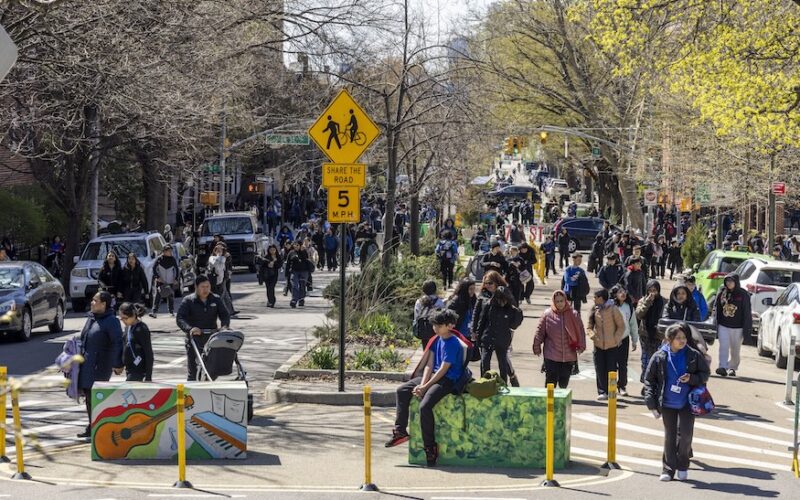
NYC DOT worked to give public space back to residents. Programs like Summer Streets grew from a Manhattan project into a 22-mile citywide event.
Other signature events—such as Car-Free Earth Day, Trick or Streets, Día de Muertos celebrations, and the Fifth Avenue Holiday Open Street—have turned roads into vibrant hubs for culture and community.
The Dining Out NYC program, which made permanent the outdoor dining options started during COVID-19, currently supports nearly 3,000 setups citywide, boosting restaurants and bringing energy to local streets.
Major Infrastructure and Daily Impact
NYC DOT finished a $300 million Brooklyn Bridge upgrade, as well as significant improvements to the Queensboro, Unionport, and Ocean Avenue pedestrian bridges.
The agency resurfaced over 1,150 lane miles every year and repaired 600,000+ potholes, cutting repair wait times by about half. These efforts directly benefit drivers, cyclists, and those who rely on buses.
On water transit, three new Ollis-class ferries launched, Staten Island Ferry switched to renewable diesel, and a new labor deal ended frequent crew shortages.
Promoting Equity for the Long Term
NYC DOT expanded safety and public space projects at the highest rate in lower-income areas, helping achieve the sharpest declines in pedestrian fatalities there.
Contracting with minority- and women-owned businesses climbed from 11% to 37% of NYC DOT spending, aiding more than 400 companies. Citi Bike and e-scooter sharing also reached farther into previously underserved neighborhoods.
Collectively, these policies aim to fix old problems of unsafe streets and inequitable investments, creating safer, more inclusive public spaces for all the city’s residents.