
NYC News Network | Local News Across New York City
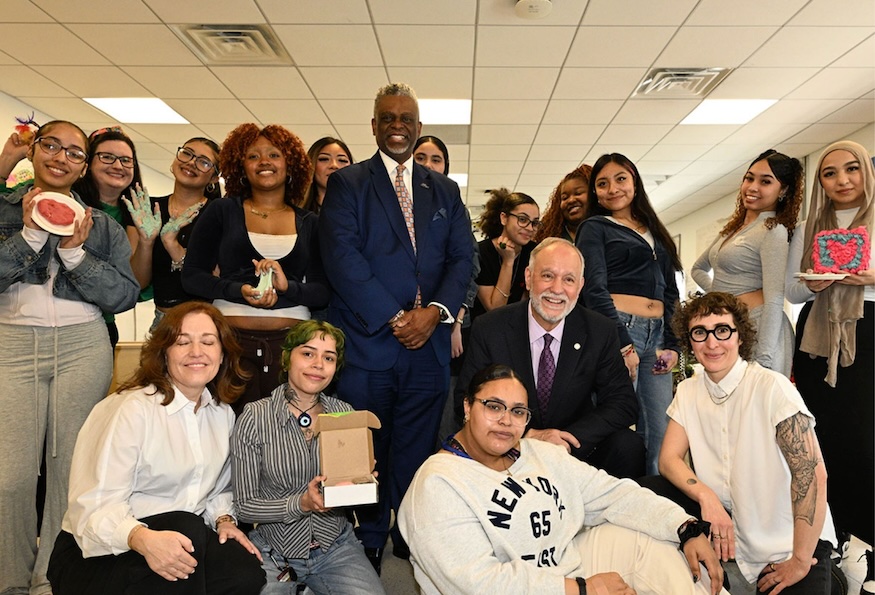
Félix V. Matos Rodríguez, chancellor of the City University of New York, recently visited a child development class at Borough of Manhattan Community College to spotlight the university’s expanding early childhood education programs and promote the state’s tuition-free CUNY Reconnect initiative.
Details about the visit were outlined in a press release published on NYC Newswire. The program allows eligible adult learners to enroll in CUNY community colleges at no cost while pursuing degrees connected to workforce shortages in fields such as education, nursing, technology, and other high-demand sectors.
During the visit, Matos Rodríguez observed a class titled Psychological Foundations of Early Development and Education, which takes place inside BMCC’s early childhood teaching laboratory. The lab is designed to resemble a functioning early learning center so students can practice hands-on activities commonly used in early childhood education settings.
“I am proud our students are learning child development skills at BMCC as they prepare to pursue a wide range of careers serving children,” said Matos Rodríguez. He added that CUNY remains ready to “meet the needs of the city and state” while helping ensure there are well-trained educators as leaders work toward expanding access to free child care for young children in New York.
The course is offered through BMCC’s Teacher Education Department and is part of the Child Care and Early Childhood Education associate degree program. Students in the program can follow either an infant and toddler track or a preschool and early elementary track as they prepare for careers working with young children.
Anthony E. Munroe, president of Borough of Manhattan Community College, said the program is designed to prepare the next generation of educators while giving adult learners a pathway back to college. “BMCC is a launch pad for the next generation of early-childhood educators,” Munroe said, noting that the tuition-free pathway created through CUNY Reconnect helps many students — including parents — enter the field.
Students participating in the class took part in breakout activities focused on sensory development, including creating scent jars, making Play-Doh, assembling sensory boxes, and building small fidget tools used in early childhood learning.
Some students said their personal experiences motivated them to pursue careers in early childhood education. Rosalinda Rodriguez, a 25-year-old returning student and parent, said she wanted to build new career opportunities while also strengthening her understanding of child development.
“I’m a single mom and I feel like a teacher every day for my son. I really wanted to give myself better work opportunities and expand my knowledge,” Rodriguez said.
First-year student Allison Carino said her interest in the class was influenced by a family member. “I wanted to learn about how to help children with disabilities; how to have patience. I’m learning how to see children in a different way,” she said.
Since launching last summer, CUNY Reconnect has helped nearly 6,000 New Yorkers between the ages of 25 and 55 enroll tuition-free at community colleges across the CUNY system. The program supports degree programs connected to workforce needs, including fields such as advanced manufacturing, artificial intelligence, cybersecurity, engineering, health care and green energy.
As part of her FY2027 executive budget proposal, Kathy Hochul has proposed expanding the initiative to include additional career pathways such as emergency management, transportation, and air traffic control, while also allowing adults who already hold a degree to pursue nursing through the program.
Prospective students interested in the program can learn more at the CUNY website.
CUNY officials say the university is expanding early childhood education programs to support broader efforts to improve access to affordable child care across New York under Governor Hochul and New York City Mayor Zohran Mamdani.
Across the university system, more than 3,600 students are currently enrolled in early childhood education programs offered at 13 CUNY colleges. These programs span multiple degree levels and include specialized training in bilingual education and special education.
The university also operates the CUNY New York Early Childhood Professional Development Institute, a statewide partnership that provides training resources and career support for individuals pursuing credentials in early childhood education.
In addition, the institute launched the NYC Early Childhood Apprenticeship Program with support from the city’s Office of Talent and Workforce Development. The program provides job training and connects apprentices with assistant teacher positions while they earn a tuition-free Child Development Associate certificate through the CUNY School of Professional Studies.
Education remains one of CUNY’s largest academic fields. In the 2022-2023 academic year, one out of every 20 undergraduate degrees awarded across the university system was in education. The university also prepares more than one-third of incoming teachers for New York City public schools and more than 40 percent of teachers of color statewide.
CUNY also plays a key role in the NYC Teaching Fellows initiative, which recruits college graduates to teach in high-need subject areas in New York City public schools. Last year, the university placed 526 fellows into master’s degree programs, more than triple the number enrolled at CUNY the year before.
Beyond academic programs, the university operates 17 campus-based child care centers serving student-parents, faculty, and staff, as well as families in surrounding communities. A new child care center is also planned at Queensborough Community College following a $3.1 million federal allocation secured by Chuck Schumer and Grace Meng.