

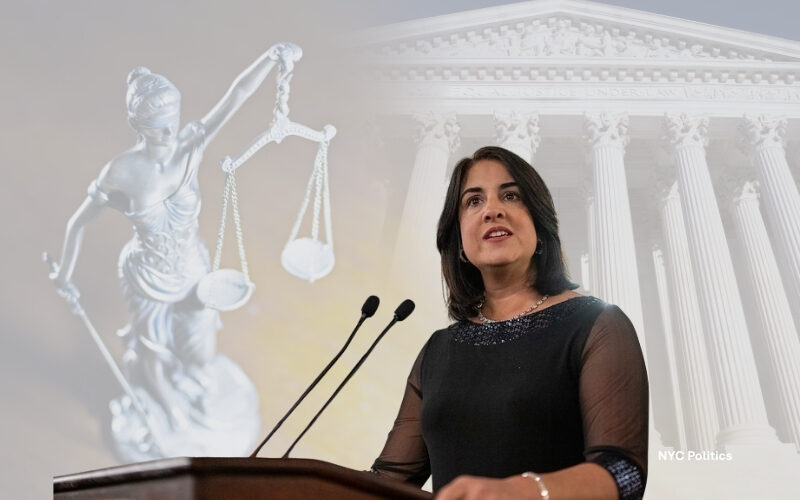
A legal battle over New York’s congressional boundaries has taken a major turn after the Supreme Court of the United States allowed a Republican challenge to move forward, leaving NYC’s lone GOP district intact for now and intensifying the broader political conflict surrounding redistricting in the state.
The ruling affects New York’s congressional map, particularly the district represented by Nicole Malliotakis, the only Republican member of Congress representing a district based in New York City. Her district, which covers parts of Staten Island and southern Brooklyn, has become a focal point in the ongoing debate over how political boundaries are drawn across the state.
Although the decision does not immediately redraw district lines, it signals that federal courts may continue reviewing how New York’s congressional map was created, keeping the issue at the center of state and national political discussions ahead of future elections.
Background of the Redistricting Dispute
The case stems from New York’s latest redistricting cycle following the 2020 census. Population shifts required the state to redraw congressional districts to ensure equal representation.
Responsibility for creating the new boundaries initially fell to the New York Independent Redistricting Commission, a bipartisan body designed to reduce partisan influence over district maps. However, disagreements within the commission led to competing proposals that ultimately pushed the process back to the New York State Legislature.
Lawmakers eventually approved a new congressional map, but the plan quickly faced legal challenges from Republican groups and voters who argued the lines were drawn in a way that favored Democratic candidates.
Opponents claimed the map diluted Republican voting strength and altered district boundaries in ways that could significantly impact electoral outcomes.
Supporters of the map argued that the changes were necessary to reflect population shifts and maintain compliance with federal voting laws.
Why NYC’s Lone GOP District Became Central
Among the most closely watched districts in the dispute is the one represented by Nicole Malliotakis.
Her district has long been politically competitive but remains the only Republican-held congressional district tied to New York City, giving it outsized significance in statewide political calculations.
The area includes:
-
Much of Staten Island
-
Portions of southern Brooklyn including neighborhoods with diverse political demographics
Because of its unique political composition, the district has been a frequent subject of debate during past redistricting cycles.
Changes to its boundaries could influence which party controls the seat in future elections, making it one of the most closely monitored districts in the state.
Supreme Court’s Role in the Case
The involvement of the Supreme Court does not represent a final decision on the constitutionality of the map. Instead, the justices declined to block legal challenges brought by Republican plaintiffs, allowing the case to continue moving through the federal court system.
This procedural move effectively keeps the dispute alive and preserves the current district configuration while litigation continues.
Legal observers note that redistricting battles often move through multiple levels of the court system before reaching a final resolution.
By allowing the challenge to proceed, the Supreme Court ensured that the arguments surrounding the fairness of the congressional map will continue to be examined.
Broader Political Stakes
Redistricting is one of the most consequential processes in American politics because it determines how communities are represented in Congress.
Control over district boundaries can shape electoral competition for an entire decade until the next census triggers another round of redrawing.
In New York, the debate has been especially intense because the state lost a congressional seat after the 2020 census due to population changes.
That loss forced lawmakers to restructure existing districts, often combining or reshaping areas that previously had distinct political identities.
As a result, several congressional seats across the state became more competitive or experienced significant geographic changes.
The battle over NYC’s lone GOP district illustrates how even a single district can carry major political implications when statewide power balances are involved.
Community Impact Across NYC Boroughs
While the legal dispute focuses on congressional maps, the outcome could influence representation for communities across multiple boroughs.
Staten Island
Residents of Staten Island are directly affected because the borough forms the core of the district currently represented by Nicole Malliotakis. Changes to district lines could alter which communities are grouped together for federal representation.
Brooklyn
Parts of southern Brooklyn are also included in the district. These neighborhoods often feature mixed political voting patterns, which can make election outcomes less predictable.
Broader NYC Representation
Although the district itself covers only certain neighborhoods, redistricting decisions often create ripple effects that influence surrounding districts as well. Adjusting one boundary can force changes to adjacent districts, affecting representation across a wider area of the city.
Election Implications
The court fight arrives at a time when congressional races nationwide are becoming increasingly competitive.
In New York, control of key districts can play a role in determining which party holds the majority in the United States House of Representatives.
Because New York has historically leaned Democratic in federal elections, the survival of NYC’s lone GOP district carries symbolic and strategic importance for Republicans seeking to maintain a foothold in the city’s political landscape.
Political analysts note that even minor adjustments to district boundaries can significantly influence election dynamics by changing the balance of voters within a district.
As a result, legal challenges over redistricting often continue for years as parties attempt to shape maps that strengthen their electoral prospects.
What Happens Next in the Legal Process
Although the Supreme Court allowed the challenge to proceed, the underlying case will continue through lower courts before any final decision is reached.
Possible outcomes include:
-
Federal courts upholding the current district map
-
Courts ordering adjustments to specific district boundaries
-
New legal appeals that could eventually return to the Supreme Court
Because election cycles occur every two years, the timing of court rulings could determine whether any changes affect upcoming races or only future elections.
For now, the existing map remains in place, meaning voters in Staten Island and parts of Brooklyn will continue to be represented under the current district configuration.
Why Redistricting Battles Continue Nationwide
New York is far from the only state experiencing legal disputes over congressional maps.
Across the country, courts regularly hear challenges related to:
-
Allegations of partisan gerrymandering
-
Compliance with the U.S. Department of Justice voting rights protections
-
Representation for minority communities
-
Population equality requirements
These disputes highlight the ongoing tension between political interests and efforts to ensure fair representation.
Because congressional maps influence political power for years at a time, even small changes can carry enormous long-term consequences.
Final Thoughts
The Supreme Court’s decision to allow the legal challenge to continue ensures that the debate over NYC’s lone GOP district will remain a major political issue in New York.
While the ruling does not immediately alter district lines, it keeps the fight over redistricting alive and signals that courts will continue scrutinizing how congressional maps are drawn.
For voters in Staten Island, Brooklyn, and across New York City, the outcome could shape how communities are represented in Congress for years to come.
As the case moves forward through the legal system, policymakers, candidates, and voters alike will be watching closely to see whether the state’s congressional map ultimately changes or remains intact.
Sources & Official References
U.S. Supreme Court – Case Docket and Orders
https://www.supremecourt.gov/
New York State Redistricting Information – Congressional Maps
https://www.nyirc.gov/
New York State Legislature – Redistricting Process
https://www.nysenate.gov/
U.S. House of Representatives – Member Information (Nicole Malliotakis)
https://malliotakis.house.gov/
U.S. Census Bureau – 2020 Census Redistricting Data
https://www.census.gov/programs-surveys/decennial-census/about/rdo.html
U.S. Supreme Court — Malliotakis v. Williams (2026)
https://www.supremecourt.gov/opinions/25pdf/25a914_1p24.pdf
What Readers Want to Know
Why is NYC’s lone GOP district important?
The district is the only congressional seat tied to New York City currently represented by a Republican, making it politically significant in statewide election dynamics.
Does the Supreme Court ruling change district boundaries now?
No. The decision allows the legal challenge to continue but does not immediately redraw district lines.
Which areas are part of the district?
The district includes most of Staten Island and portions of southern Brooklyn, communities with varied political demographics.
Could the map still change before future elections?
Yes. Depending on future court rulings, adjustments to New York’s congressional map could occur later in the legal process.














Leave a Reply
You must be logged in to post a comment.